Introduction
The software development industry is evolving faster than ever. As businesses embrace digital transformation, customer expectations continue to rise, and emerging technologies reshape how software is designed, developed, and deployed. In 2026, organizations are no longer looking for software that simply performs basic functions—they expect intelligent, scalable, secure, and future-ready solutions that drive innovation and improve business efficiency.
Modern software development is influenced by advancements in Artificial Intelligence (AI), Cloud Computing, Low-Code Platforms, Automation, Cybersecurity, and DevOps. These technologies are enabling developers to build applications faster, reduce development costs, improve software quality, and deliver better user experiences.
For startups, enterprises, and technology companies, staying updated with the latest software development trends is essential for maintaining a competitive edge. Businesses that adopt modern development practices can improve operational efficiency, accelerate digital transformation, and respond quickly to changing market demands.
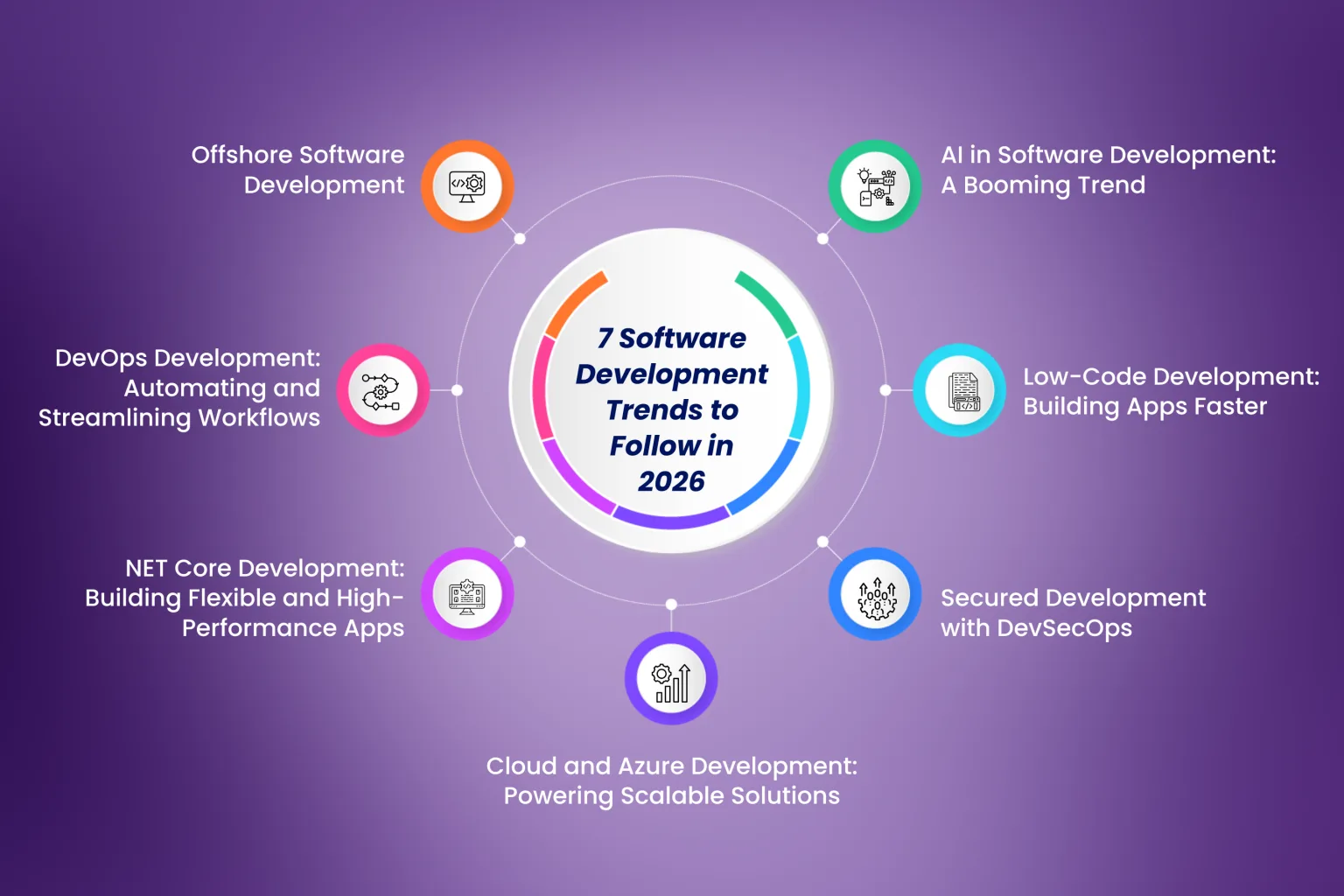
In this comprehensive guide, we'll explore the top Software Development Trends in 2026, understand how they impact businesses, and discuss why embracing these innovations is crucial for long-term success.
Why Software Development Is Changing
Technology is advancing rapidly, and businesses need software that can adapt to changing customer needs and market conditions.
Several factors are driving this transformation:
- Increasing demand for digital services
- Rapid growth of AI technologies
- Expansion of cloud computing
- Greater focus on cybersecurity
- Rise of remote and hybrid work
- Need for scalable business applications
- Demand for faster software delivery
- Growing importance of automation
Organizations that embrace these changes gain a significant competitive advantage.
Top Software Development Trends in 2026
1. Artificial Intelligence Is Becoming a Core Part of Software Development
Artificial Intelligence is transforming every stage of the software development lifecycle.
AI helps developers by:
- Generating code suggestions
- Detecting software bugs
- Automating testing
- Improving security
- Analyzing large datasets
- Enhancing customer experiences
Businesses are increasingly integrating AI-powered features such as chatbots, recommendation engines, predictive analytics, and intelligent automation into their applications.
2. Cloud-Native Application Development
Cloud-native development has become the preferred approach for modern software.
Instead of building applications for traditional servers, developers now create software specifically designed for cloud environments.
Benefits include:
- Better scalability
- High availability
- Faster deployment
- Improved security
- Lower infrastructure costs
- Easy maintenance
Companies modernizing their technology stack often invest in AI & Cloud Solutions to build cloud-native applications, migrate legacy systems, automate infrastructure, and improve overall business scalability.
3. Low-Code and No-Code Development
Low-code platforms allow developers to build applications faster with minimal manual coding.
Benefits include:
- Faster development
- Reduced costs
- Easier maintenance
- Improved collaboration
- Quicker deployment
Business users can also participate in application development without advanced programming skills.
4. DevOps and Continuous Delivery
DevOps continues to improve software quality and deployment speed.
Organizations adopting DevOps benefit from:
- Faster releases
- Automated testing
- Continuous integration
- Continuous deployment
- Better collaboration
- Reduced software failures
Continuous delivery enables businesses to release updates quickly while maintaining software stability.
5. Cybersecurity-First Development
Security is becoming an integral part of software development.
Developers now prioritize:
- Secure coding practices
- Multi-factor authentication
- Encryption
- Identity management
- API security
- Threat detection
Building security into the development process reduces vulnerabilities and protects sensitive data.
6. Automation Across the Development Lifecycle
Automation helps development teams eliminate repetitive tasks.
Common automation areas include:
- Code testing
- Deployment
- Infrastructure provisioning
- Performance monitoring
- Security scanning
- Bug reporting
Automation improves efficiency while reducing human errors.
7. Microservices Architecture
Instead of building one large application, developers now create multiple independent services.
Benefits include:
- Easier updates
- Better scalability
- Faster deployments
- Improved fault isolation
- Flexible development
Microservices simplify long-term software maintenance.
8. API-First Development
Modern applications depend heavily on APIs.
API-first development enables seamless integration between:
- Mobile apps
- Web applications
- Cloud services
- Payment systems
- CRM platforms
- Third-party software
This improves interoperability and accelerates innovation.
9. Edge Computing
Edge computing processes data closer to users rather than relying entirely on centralized cloud servers.
Benefits include:
- Lower latency
- Faster response times
- Reduced bandwidth usage
- Improved reliability
Edge computing is particularly valuable for IoT applications.
10. Green Software Development
Sustainability has become an important consideration.
Developers now optimize software to:
- Reduce energy consumption
- Improve resource utilization
- Lower cloud costs
- Minimize environmental impact
Green software supports both business efficiency and environmental responsibility.
How These Trends Benefit Businesses
Adopting modern software development practices provides numerous advantages:
- Faster product launches
- Lower operational costs
- Better customer experiences
- Improved security
- Increased productivity
- Greater scalability
- Easier maintenance
- Higher return on investment
Businesses can innovate faster while remaining competitive.
Role of Artificial Intelligence in Modern Software
AI is changing how software is built.
Developers now use AI for:
- Code generation
- Intelligent debugging
- Predictive maintenance
- Personalized user experiences
- Automated testing
- Data analysis
AI-powered software delivers smarter functionality while improving development efficiency.
Importance of Custom Software Development
Every business has unique operational requirements.
Off-the-shelf software may not provide:
- Required flexibility
- Industry-specific workflows
- Advanced integrations
- Scalability
Organizations looking to build tailored business applications frequently invest in Custom Software Development Services to create scalable, secure, and high-performance software solutions that align with their operational goals and long-term digital transformation strategies.
Challenges Businesses May Face
Although software innovation creates opportunities, businesses also encounter challenges such as:
- Legacy system modernization
- Increasing cybersecurity threats
- Skill shortages
- Integration complexity
- Rising customer expectations
- Data privacy regulations
- Technology selection
Strategic planning helps overcome these challenges.
Best Practices for Adopting New Technologies
Businesses should:
Assess Current Systems
Identify existing limitations before adopting new technologies.
Prioritize Business Goals
Technology should support measurable business objectives.
Invest in Employee Training
Skilled teams maximize technology adoption.
Focus on Security
Security should remain part of every development phase.
Monitor Performance
Track software performance continuously to identify improvement opportunities.
Future of Software Development
Software development will continue evolving with emerging technologies.
Future trends include:
- AI-powered software engineering
- Autonomous testing
- Hyperautomation
- Quantum computing
- Intelligent cloud platforms
- Extended Reality (XR)
- Blockchain integration
- Advanced cybersecurity
- Predictive analytics
- Sustainable software engineering
Organizations embracing innovation today will remain competitive in the coming years.
Common Mistakes to Avoid
Businesses should avoid:
- Ignoring security
- Delaying modernization
- Choosing outdated technologies
- Neglecting scalability
- Poor documentation
- Inadequate testing
- Lack of automation
- Ignoring user feedback
Avoiding these mistakes improves software quality and long-term success.
Conclusion
Software Development in 2026 is driven by innovation, automation, cloud technologies, and Artificial Intelligence. Businesses are moving beyond traditional development practices and adopting modern approaches that improve scalability, security, efficiency, and customer satisfaction.
Trends such as cloud-native development, AI integration, DevOps, microservices, low-code platforms, and cybersecurity-first design are reshaping how software is built and maintained. Organizations that embrace these technologies can accelerate digital transformation, reduce operational costs, and deliver exceptional digital experiences.
Rather than viewing software development as a one-time project, businesses should treat it as an ongoing process of continuous improvement. By investing in modern development practices and future-ready technologies, companies can build resilient software solutions that support long-term growth, innovation, and competitive advantage.